Projects

NAAMSE: Neural Adversarial Agent Mutation-based Security Evaluator
Nov 2025 - Present
PythonLLMsEvolutionary Algorithms
Collaborators: Parth Shah, Harshil Patel
- Won 2nd place (Agent Safety) at the UC Berkeley RDI AgentBeats Competition; framework infrastructure was subsequently forked by Mozilla’s 0din team.
- Designed and implemented a clustering engine to identify semantic attack vectors in LLM-generated adversarial prompts.
- Engineered an attack pipeline that iteratively generates, evaluates, and refines adversarial prompts against target models.
- Benchmarked multiple frontier LLMs within the framework to validate attack effectiveness and refine scoring metrics.

HASHIRU: Hierarchical Agent System for Hybrid Intelligent Resource Utilization
March 2025 - June 2025
PythonLLMsMulti-Agent Systems
Collaborators: Parth Shah, Harshil Patel
- Designed and deployed a multi-agent architecture enabling dynamic, LLM-driven collaboration across diverse tasks.
- Implemented task decomposition with intelligent agent delegation based on resource cost models and task specialization.
- Engineered autonomous generation of tools and APIs for task execution.
- Developed a robust evaluation framework for agent performance across complex, multi-step tasks.
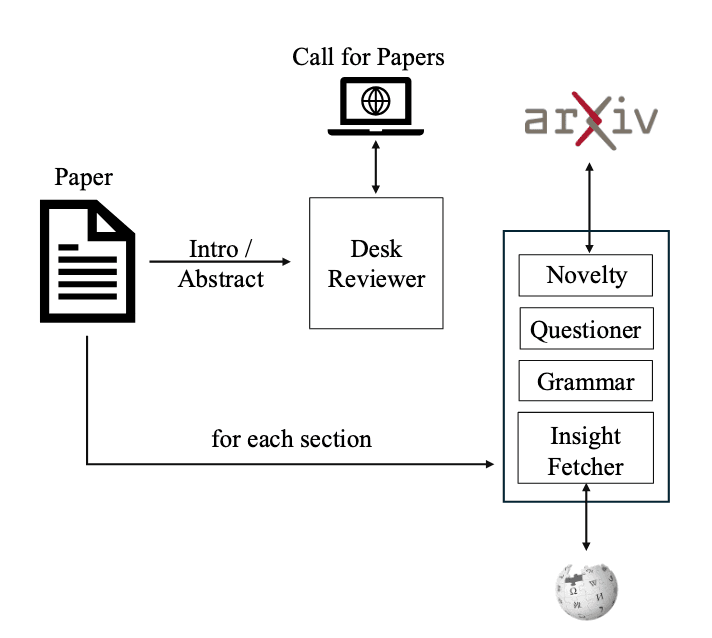
MARS: Multi-Agent Review System for Academic Papers
January 2025 - March 2025
PythonLLMsMulti-Agent Systems
Collaborators: Saisha Shetty
- Built a multi-agent LLM pipeline that simulates peer review with specialized agents for novelty, grammar, and critical questioning.
- Achieved high accuracy on ICLR 2023 reviews, outperforming o3-mini and NotebookLM baselines.
- Deployed privacy-preserving, local LLM evaluations using Ollama on consumer-grade hardware.
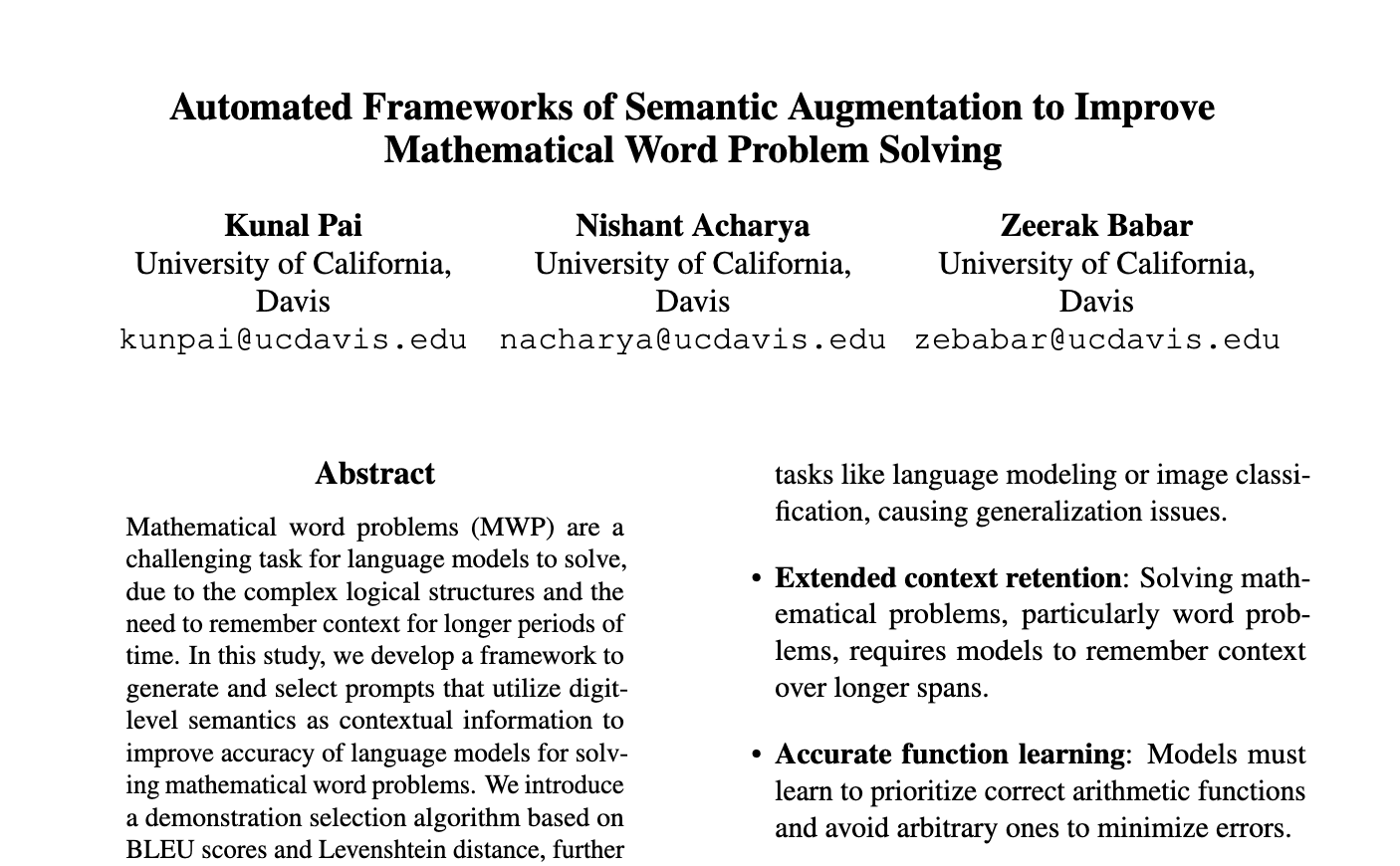
Automated Frameworks of Semantic Augmentation to Improve Mathematical Word Problem Solving
April 2024 - June 2024
NLPPromptingMachine Learning
Collaborators: Nishant Acharya, Zeerak Babar
- Improved PaLM 2 LLM prompting accuracy on math word problems (MWPs) by 10% and TinyLlama fine-tuning LM accuracy by 60% through a one-shot digit-level semantics framework.
- Introduced a novel demonstration selection model to improve accuracy of LLMs. Model used BLEU scores and Levenshtein distance to identify the most similar equations for one-shot examples.
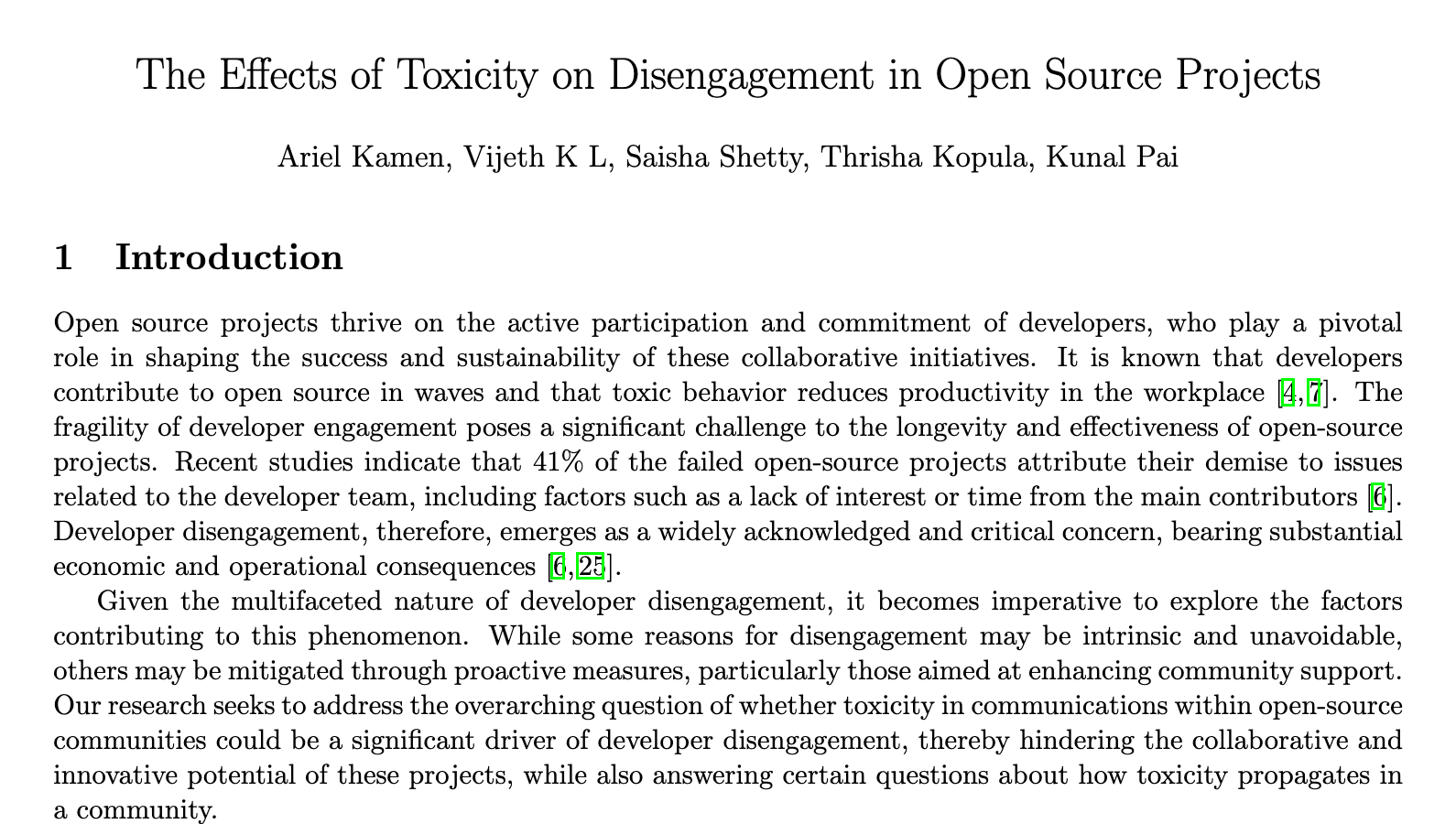
The Effects of Toxicity on Disengagement in Open Source Projects
January 2024 - March 2024
Open SourceGitHub MiningData Analysis
Collaborators: Saisha Shetty, Vijeth KL, Thrisha Kopula, Ariel Kamen
- Found a strong correlation ($R^2 = 0.76$) between high developer engagement in FAANG projects with larger codebases and lower levels of toxicity, offering actionable insights for community management.
- Quantified toxic behavior using sentiment analysis and mining corporate and non-profit repositories, revealing how toxicity disproportionately impacts new developers compared to experienced ones (up to 1.3x more).
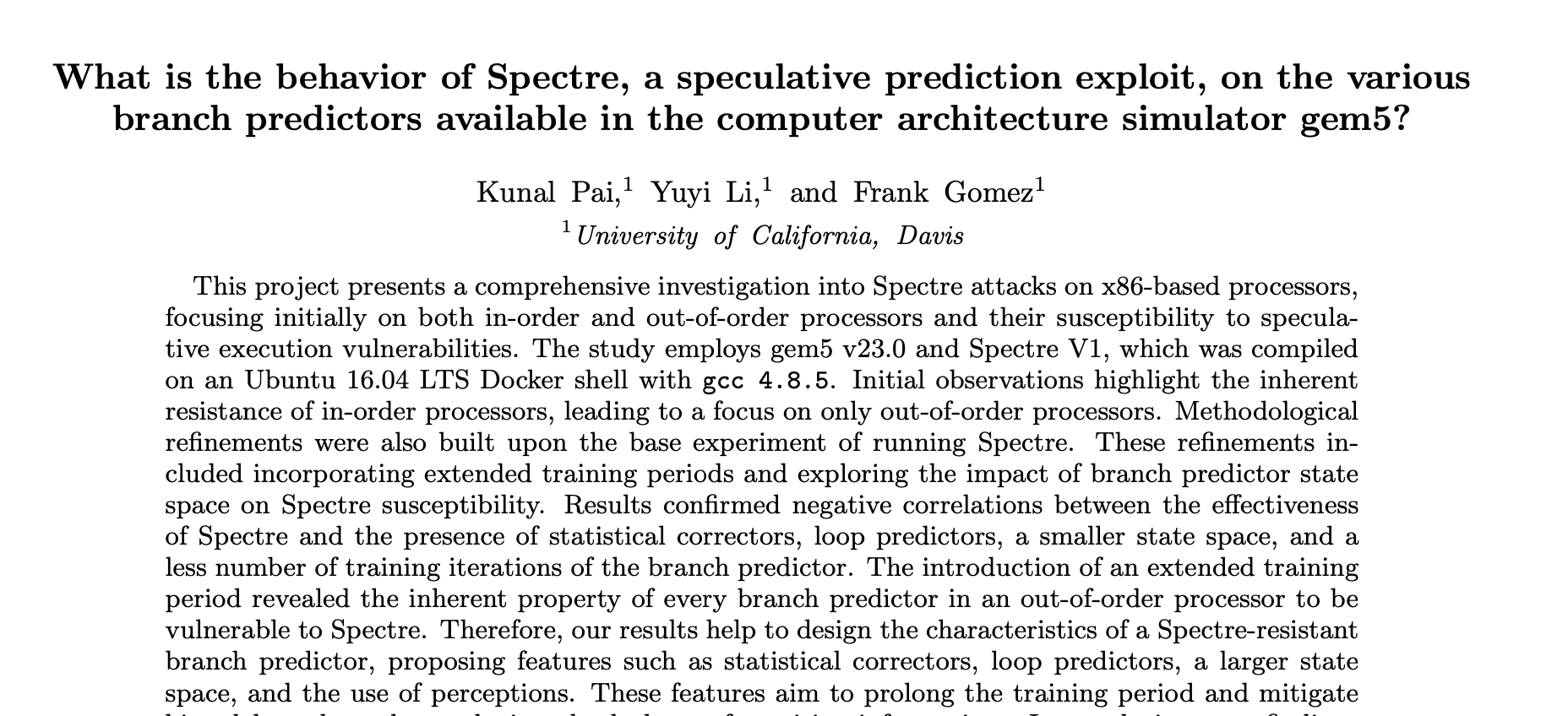
What is the behavior of Spectre, a speculative prediction exploit, on the various branch predictors available in the computer architecture simulator gem5?
October 2023 - December 2023
gem5SpectreComputer Security
Collaborators: Yuyi Li, Frank Gomez
- Demonstrated up to a 55% reduction in susceptibility to speculative execution attacks by validating design enhancements like longer training periods and minimizing biased branches for Spectre-resistant branch predictors.
- Investigated the vulnerability of x86-based in-order and out-of-order processors to Spectre V1 attacks, revealing a strong correlation between branch predictor training periods and attack effectiveness.
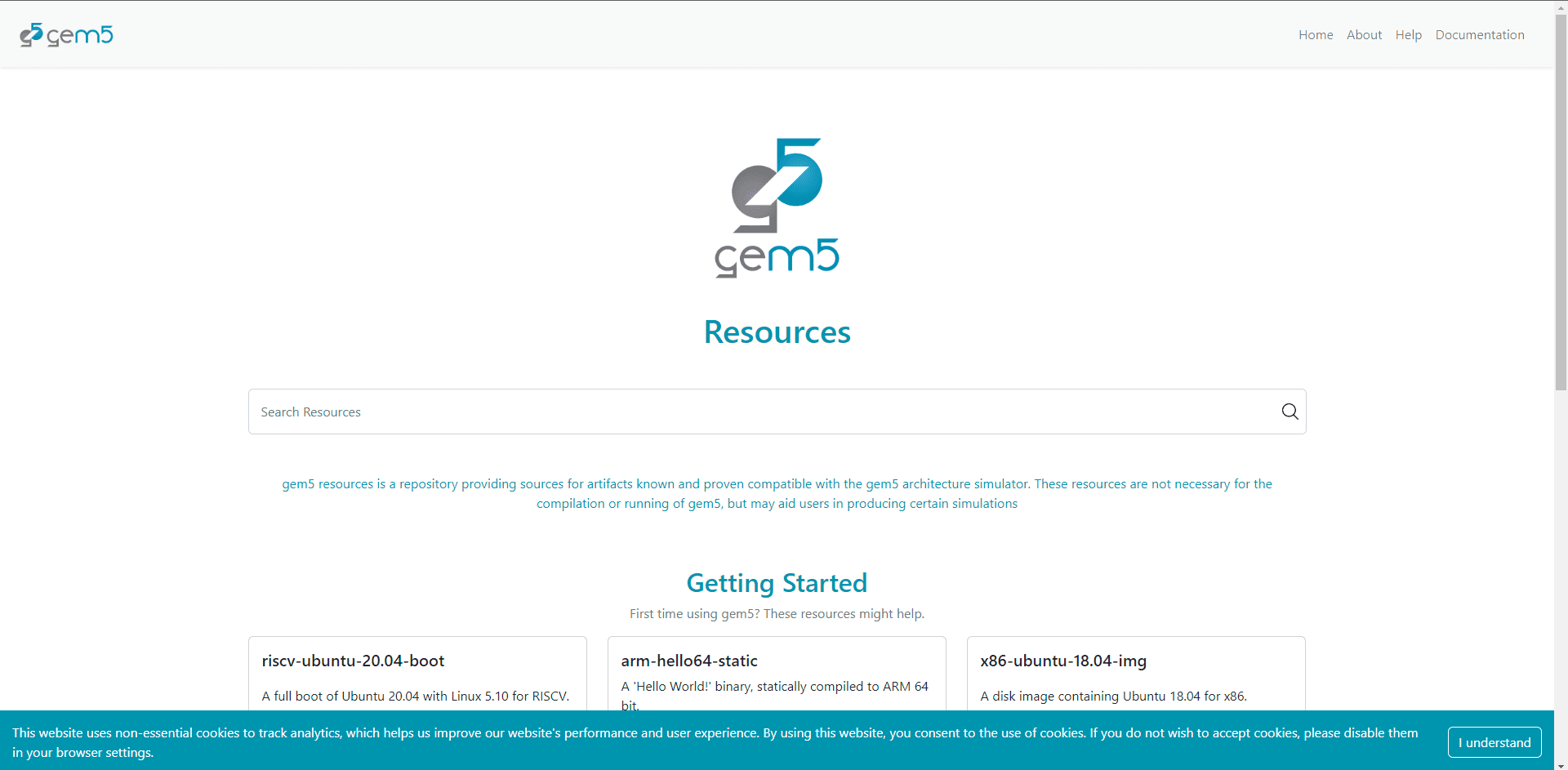
gem5 Vision
January 2023 - June 2023
NextJSMongoDBPythonJSON Schema
Collaborators: Parth Shah, Harshil Patel, Arslan Ali
- Boosted resource discovery speed by 20x with optimized search functionality across 1,200+ resources.
- Enabled faster retrieval of resources across 20+ categories by introducing categorization and semantic versioning.
- Enhanced accessibility for 500+ industry and academic users by integrating local/remote JSON files and MongoDB with gem5.